


Introduction
The vagus nerve plays a central role in autonomic regulation, inflammation control, mood modulation, and overall homeostasis. Vagus nerve stimulation (VNS) is a promising approach for enhancing autonomic balance, reducing systemic inflammation, improving mental health, and supporting neuroplasticity.
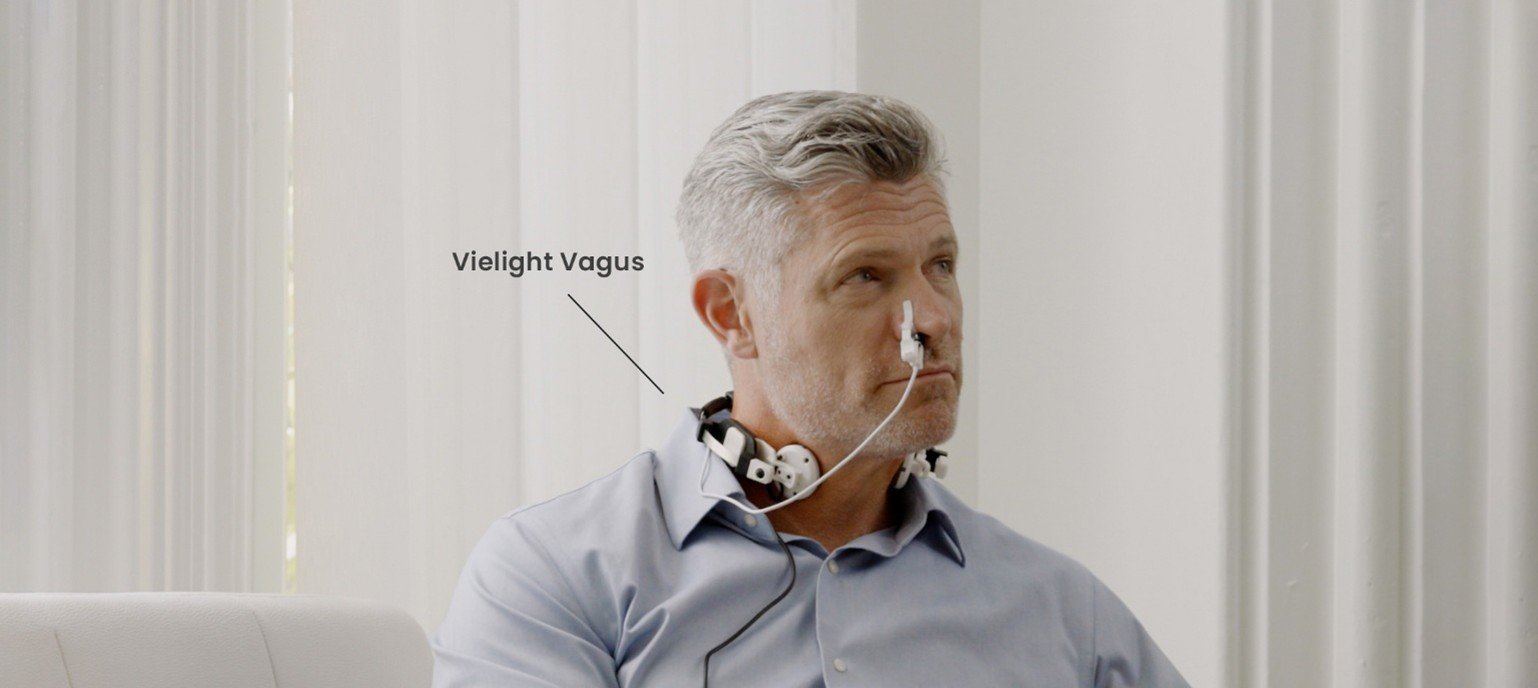
The Vielight Vagus presents an innovative, non-invasive alternative using photobiomodulation (PBM) to target the cervical vagus nerve branches with pulsed near-infrared light. Controlled clinical studies are being planned to evaluate its efficacy.
Disclaimer
The Vielight Vagus is marketed as a low-risk general wellness device without medical claims. This white paper provides biological and mechanistic context for its design.
Device Overview
- Target: Bilateral cervical vagus nerve branches under the sternocleidomastoid (SCM) muscles
- Delivery: Hands-free headset for consistent anatomical placement
- Website: Vielight Vagus Device
- Patent: Patent Information

Early Experimental Outcomes
Experiments using 810 nm PBM at 50 mW/cm² demonstrated a notable increase in vagal tone at 100 Hz pulse frequency, aligning with results from electrical VNS studies (Sclocco et al., 2020; Yokota et al., 2022).
Scientific Rationale and Mechanisms of Action
Foundational Mechanisms
PBM stimulates afferent vagal fibers via mitochondrial activation, calcium signaling, and ROS modulation [Hamblin, 2016; Karu, 1999].
Distinct from Electrical Stimulation
PBM does not rely on electrical depolarization but works through photoactivation of ion channels and metabolic support [Zhang et al., 2024; Yan et al., 2025; Farazi et al., 2024].
Potentially Shared Outcomes
- NTS Activation: fMRI studies show cervical VNS activates the NTS, DMNV, and PAG [Yakunina et al., 2020; Benarroch, 2012]
- HRV Modulation: Non-invasive VNS improves HRV, a marker for mental health resilience [Bretherton et al., 2022; Shaffer & Ginsberg, 2017]

Other Advantages of the Vielight Vagus
- 100 Hz Pulsing: Aligned with gamma frequencies for cognitive support [Herrmann et al., 2010; Yokota et al., 2022]
Helpful PBM Mechanisms of Action
- Mitochondrial upregulation via cytochrome c oxidase
- Increased ATP and nitric oxide release
- Modulation of calcium channels and ion transport
- Systemic anti-inflammatory effects
Future VNS Applications for PBM Investigation
- HRV and autonomic balance enhancement
- Stress and anxiety support
Conclusion
The Vielight Vagus device introduces a next-generation approach to non-invasive VNS. By combining the benefits of photobiomodulation with cervical vagus nerve stimulation, it offers a safe, comfortable, and effective alternative to traditional VNS methods. Its design supports home-based clinical research and HRV enhancement with minimal user burden. Vielight’s upcoming investigations aim to validate and expand its potential therapeutic applications.
References
- Ali, M. S. S., Parastooei, G., Raman, S., Mack, J., Kim, Y. S., & Chung, M. K. (2024). Genetic labeling of the nucleus of tractus solitarius neurons associated with electrical stimulation of the cervical or auricular vagus nerve in mice. Brain stimulation, 17(5), 987–1000.
- Badran, B. W., et al. (2019). The short and long-term effects of transcutaneous auricular vagus nerve stimulation on heart rate variability in healthy adults: A randomized sham-controlled trial. Brain Stimulation, 11(5), 947–955.
- Benarroch, E. E. (2012). Periaqueductal gray: An interface for behavioral control. Neurology, 78(3), 210–217.
- Bonaz, B., Sinniger, V., & Pellissier, S. (2019). Vagus Nerve Stimulation at the Interface of Brain-Gut Interactions. Cold Spring Harbor perspectives in medicine, 9(8), a034199.
- Bremner, J. D., Gurel, N. Z., Jiao, Y., Wittbrodt, M. T., Levantsevych, O. M., … Pearce, B. D. (2020). Transcutaneous vagal nerve stimulation blocks stress-induced activation of Interleukin-6 and interferon-γ in posttraumatic stress disorder: A double-blind, randomized, sham-controlled trial. Brain, behavior, & immunity – health, 9, 100138.
- Bretherton, B., Atkinson, L., Murray, A., Clancy, J., Deuchars, S. A., & Deuchars, J. (2022). Effects of transcutaneous vagus nerve stimulation on heart rate variability: A systematic review. Frontiers in Neuroscience, 16, 913159.
- Clancy, J. A., Deuchars, S. A., & Deuchars, J. (2014). The benefits of non-invasive vagus nerve stimulation for the autonomic nervous system in healthy individuals. Autonomic Neuroscience, 185, 26–31.
- Evancho, A., Do, M., Fortenberry, D., Billings, R., Sartayev, A., & Tyler, W. J. (2024). Vagus nerve stimulation in Parkinson’s disease: a scoping review of animal studies and human subjects research. NPJ Parkinson’s disease, 10(1), 199.
- Farazi, N., Salehi-Pourmehr, H., Farajdokht, F., Mahmoudi, J., & Sadigh-Eteghad, S. (2024). Photobiomodulation combination therapy as a new insight in neurological disorders: a comprehensive systematic review. BMC neurology, 24(1), 101.
- Hamblin, M. R. (2016). Mechanisms and applications of the anti-inflammatory effects of photobiomodulation. AIMS Biophysics, 3(3), 337–361.
- Herrmann, C. S., Munk, M. H. J., & Engel, A. K. (2010). Cognitive functions of gamma-band activity: Memory match and utilization. Trends in Cognitive Sciences, 8(8), 347–355.
- Johnson, R. L., & Wilson, C. G. (2018). A review of vagus nerve stimulation as a therapeutic intervention. Journal of Inflammation Research, 11, 203–213.
- Kaniusas, E., Kampusch, S., Tittgemeyer, M., Panetsos, F., Gines, R. F., … & Széles, J. C. (2019). Current Directions in the Auricular Vagus Nerve Stimulation I – A Physiological Perspective. Frontiers in neuroscience, 13, 854.
- Karu, T. (1999). Primary and secondary mechanisms of action of visible to near-IR radiation on cells. Journal of Photochemistry and Photobiology B: Biology, 49(1), 1–17.
- Kim, A. Y., Marduy, A., de Melo, P. S., Gianlorenco, A. C., Kim, …. & Fregni, F. (2022). Safety of transcutaneous auricular vagus nerve stimulation (taVNS): a systematic review and meta-analysis. Scientific reports, 12(1), 22055.
- Kreuzer, P. M., Landgrebe, M., Husser, O., Resch, M., Schecklmann, M., Geisreiter, F., … & Langguth, B. (2012). Transcutaneous Vagus Nerve Stimulation: Retrospective Assessment of Cardiac Safety in a Pilot Study. Frontiers in Psychiatry, 3, 70.
- Polak, J. F., et al. (2014). Cervical Vagus Nerve Anatomy in Humans: Implications for Vagus Nerve Stimulation. Pacing and Clinical Electrophysiology, 37(6), 765–773.
- Rodriguez, L., Pou, C., Lakshmikanth, T., Zhang, J., Mugabo, C. H., …. & Brodin, P. (2023). Achieving symptom relief in patients with myalgic encephalomyelitis by targeting the neuro-immune interface and optimizing disease tolerance. Oxford open immunology, 4(1), iqad003.
- Rush, A. J., et al. (2005). Vagus nerve stimulation (VNS) for treatment-resistant depressions: A multicenter study. Biological Psychiatry, 58(5), 355–363.
- Shaffer, F., & Ginsberg, J. P. (2017). An Overview of Heart Rate Variability Metrics and Norms. Frontiers in Public Health, 5, 258.
- Shamloo, S., Defensor, E., Ciari, P., Ogawa, G., Vidano, L., … & Barron, A. E. (2023). The anti-inflammatory effects of photobiomodulation are mediated by cytokines: Evidence from a mouse model of inflammation. Frontiers in neuroscience, 17, 1150156.
- Shi, C., Flanagan, S. R., & Samadani, U. (2013). Vagus nerve stimulation to augment recovery from severe traumatic brain injury impeding consciousness: a prospective pilot clinical trial. Neurological research, 35(3), 263–276.
- Silberstein, S. D., Mechtler, L. L., Kudrow, D. B., Calhoun, A. H., McClure, C. K.,… & Yarnitsky, D. (2016). Non-Invasive Vagus Nerve Stimulation for the Acute Treatment of Cluster Headache: Findings From the Randomized, Double-Blind, Sham-Controlled ACT1 Study. Headache, 56(8), 1317–1332.
- Sclocco, R., et al. (2019). The influence of respiration on brainstem and cardiovagal response to auricular vagus nerve stimulation: A multimodal ultrahigh-field fMRI study. Brain Stimulation, 12(4), 911–921.
- Tracey, K. J. (2002). The inflammatory reflex. Nature, 420(6917), 853–859.
- Yakunina, N., Kim, S. S., & Nam, E.-C. (2020). Optimization of Transcutaneous Vagus Nerve Stimulation Using Functional MRI. Brain Stimulation, 13(3), 734–744.
- Yan, B., Zhou, J., Yan, F., Gao, M., Tang, J., … & Luo, Y. (2025). Unlocking the potential of photobiomodulation therapy for brain neurovascular coupling: The biological effects and medical applications. Journal of cerebral blood flow and metabolism: official journal of the International Society of Cerebral Blood Flow and Metabolism, 271678X241311695. Advance online publication.
- Yokota, H., Edama, M., Hirabayashi, R., Sekine, C., Otsuru, N., Saito, K., Kojima, S., Miyaguchi, S., & Onishi, H. (2022). Effects of Stimulus Frequency, Intensity, and Sex on the Autonomic Response to Transcutaneous Vagus Nerve Stimulation. Brain Sciences, 12(8), 1038.
- Zhang, Y., et al. (2014). Mechanisms of low level light therapy. Proceedings of SPIE, 8932, Mechanisms for Low-Light Therapy IX, 893207.
- Zhang, Z., Zhang, Z., Liu, P., Xue, X., Zhang, C., … & Wang, F. (2024). The Role of Photobiomodulation to Modulate Ion Channels in the Nervous System: A Systematic Review. Cellular and molecular neurobiology, 44(1), 79.
- Zheng, Z. S., Simonian, N., Wang, J., & Rosario, E. R. (2024). Transcutaneous vagus nerve stimulation improves Long COVID symptoms in a female cohort: a pilot study. Frontiers in neurology, 15, 1393371.